
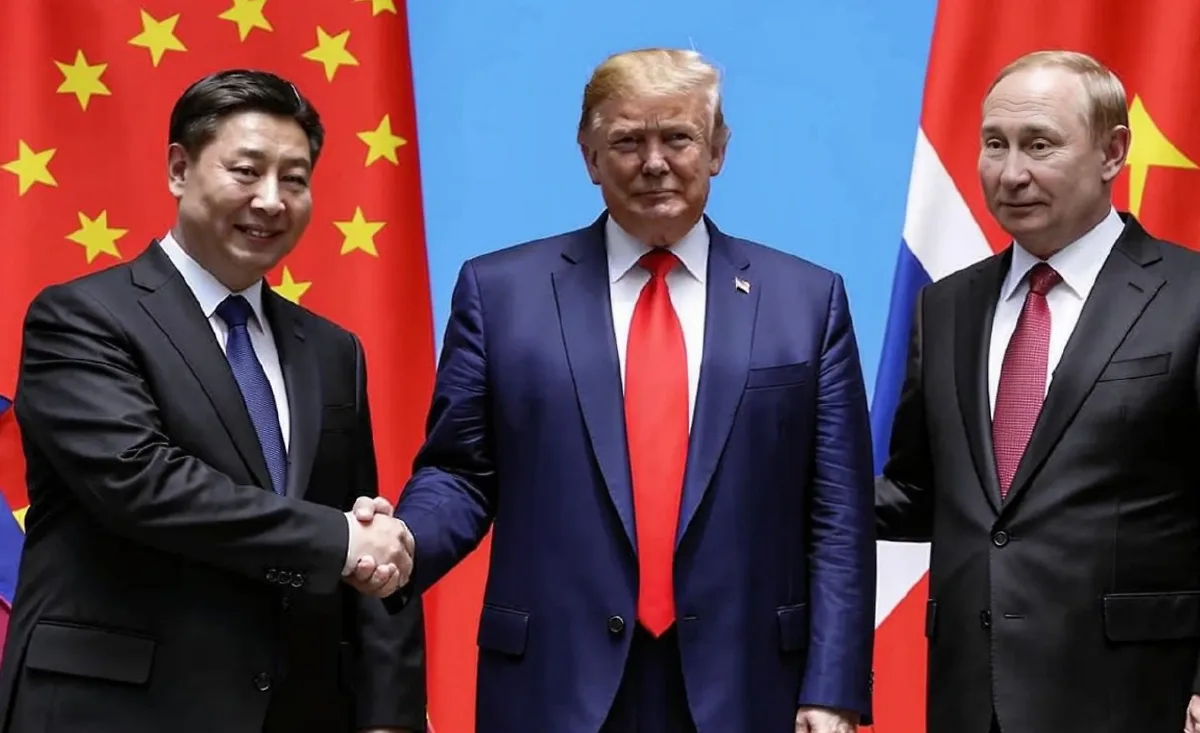
Three Chairs, One Stage: Will Putin, Trump, and Xi Meet Before the End of 2026?
A dispute is live on Winion over whether a Putin–Trump–Xi trilateral meeting will be officially confirmed by December 31, 2026. We break down where the wording traps lie and what you’re really betting on.
There are questions that sound like a heading from a diplomacy textbook and turn out to be a great excuse for a dispute. That’s exactly what’s live on Winion: Will a Putin–Trump–Xi trilateral meeting be officially confirmed by 31 December 2026? Two outcomes—«Yes» and «No»—a pool of 2.00 USDT, and a deadline of December 31, 2026, 23:59:59 UTC. A year and a half to warm up, an entire era to change your mind.
At first glance, what’s so hard? Either three leaders stand in a row in front of the cameras, or they don’t. But in disputes like this, the devil lives not in the photo but in the word «officially.» That’s what turns a simple political forecast into an exercise in reading press releases between the lines.
The triad everyone announces but the participants themselves
Bilateral meetings are routine: summits, fields, hallways, protocol handshakes. The three-way format, though, is a rare genre—almost like an eclipse. It requires not only calendars to line up but also each side’s desire to look good in that frame. One wants to show that people are talking to him again. Another wants to show he can cut deals where others only issue statements. The third simply doesn’t like a stage where he isn’t guaranteed the lead role.
That’s why news of a «possible meeting» shows up with enviable regularity: now on the sidelines of a big forum, now in backrooms, now in someone’s optimistic comment. It’s neither a lie nor the truth—it’s diplomatic fog, and everyone reads it their own way.
The word «officially» is the main trap in this dispute
The dispute resolves not on rumors but on official confirmation. Sounds fair, but in practice it’s a filter that far from everything passes through. Here’s what definitely shouldn’t count as a signal:
- «A source close to the negotiations» from an anonymous Telegram channel
- A hallway handshake that journalists called historic
- The phrase «we don’t rule out the possibility» from a press secretary
- A nice collage someone put together from three official portraits
- A rumor that was retold three times and on the third pass was called a leak
A joint statement, a coordinated announcement, or a confirmed agenda—that’s closer to the real thing. The difference between «we discussed» and «we announced» is worth more in disputes like this than it seems.
The case for «Yes»: a summit always has lobbyists
The three-way format has powerful support—not political, but decorative. The world likes big pictures: three flags, three press pools, one shared backdrop. Such a meeting is easy to sell as a «de-escalation,» a «new architecture,» and a «historic chance»—and everyone wants to sell it, except possibly the participants themselves.
- Major international venues in 2026 themselves create a reason to be in one place
- Each side needs at least one convincing foreign-policy photo op
- The U.S. midterms push the White House toward big storylines
- The format can easily be labeled “consultative”—and thereby lower the stakes
The case for «No»: three egos won’t fit on one stage
- Protocol: who sits in the center, who speaks first, whose statement comes out earlier
- Agenda: three countries rarely want to discuss the same thing on the same day
- Domestic politics: any joint photo instantly becomes ammunition for critics at home
- “Officially confirmed” is a high bar that’s easy to miss
A summit on the record isn’t about friendship; it’s about protocol. And most often it dies not in the negotiations but in agenda coordination.
How to look at this as a market, not a guessing game
The beauty of an opinion market is that it doesn’t require you to be an expert on the Kremlin, the White House, and Zhongnanhai all at once. It requires something else: carefully separating signal from noise. If a year from now you see a joint statement with a date, a city, and an agenda—that’s «Yes.» If you see three statements about how «the parties exchanged views» in different parts of the world—that’s «No» with a very polite face.
And yes, the pool is still 2.00 USDT—an amount that won’t buy you a front-row seat. But in disputes like this, what wins isn’t the size of the bankroll; it’s the ability to read wording. Here, that’s literally the main skill.
The bottom line? Betting «Yes» is believing politicians care more about a striking image than protocol wrangling. Betting «No» is believing the wrangling always wins. Link to the dispute here, deadline—end of 2026. So what do you think: three people at one table—is that diplomacy already, or still just a photograph?
Qué muestra el mercado de Winion
Un mercado público de opiniones agrega posiciones sobre resultados. La probabilidad mostrada refleja el volumen, no una encuesta ni un pronóstico oficial de la plataforma.
Preguntas frecuentes
- ¿Cómo se relaciona el artículo con el mercado de Winion?
- Puede haber un mercado público vinculado: las probabilidades reflejan posiciones de participantes, no un veredicto editorial.
- ¿Qué significa la probabilidad?
- Es una vista normalizada del volumen entre resultados; cambia con nuevas posiciones.
- ¿Cómo abrir una posición?
- Usa el botón para ir a la tarjeta del mercado en Winion y elegir un resultado.
- ¿Es asesoramiento financiero?
- No. Winion no es asesoramiento de inversión.
Disputa relacionada